Metro's $300 million bus rapid transit project on Reading Road is on schedule to break ground in spring 2027, with service launching in 2028.
Sharyn LaCombe, Metro's senior director of Bus Rapid Transit (BRT) and design, told a Cincinnati City Council committee on Tuesday, Oct. 27, that the Reading Road corridor will stretch 9.2 miles with 13 stations. The project, called MetroRapid, would use dedicated bus lanes along portions of the route, according to WLWT.
A second corridor along Hamilton Avenue, at 8.8 miles with 11 stations, is set to launch in 2029, LaCombe said. Once both lines are running, buses between the University of Cincinnati and the Banks would arrive every five minutes.
What the service looks like
MetroRapid buses would stop every 10 minutes between 6 a.m. and 8 p.m. and carry the same fare as regular bus routes, LaCombe said. Riders would tap credit cards or Metro cards to board.
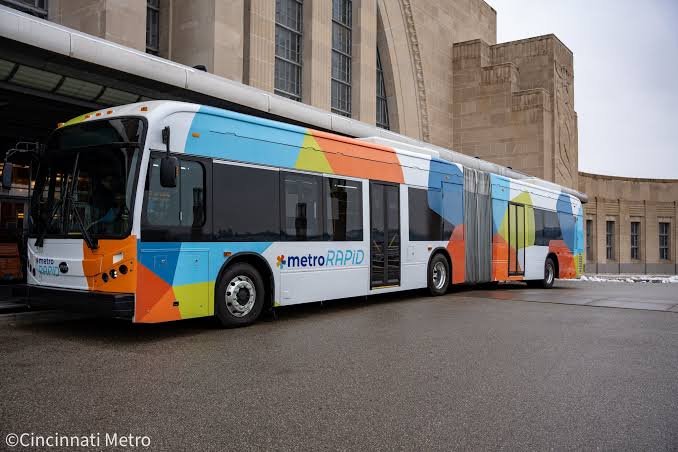
Metro has ordered 60-foot articulated buses for the service. Standard Metro buses are 40 feet long. "We need them now. We have a lot of standing-room only during our peak period," LaCombe said.
Traffic signal technology would let buses communicate with signals to hold green lights longer, reducing delays at intersections, WLWT reported. Metro is targeting trips 20% faster than conventional bus service, though updated travel-time analysis remains unfinished.
The Reading Road line follows the existing Route 43, which carries 4,000 to 5,000 riders a day. LaCombe and Khaled Shammout, Metro’s deputy innovation and vision officer, estimated ridership would climb to 6,000 to 7,000 daily once the new service begins.
Design changes after public input
The Oct. 27 presentation focused on changes made after public comment, according to Signal Cincinnati. A planned center bus lane on the Vine Street hill between Findlay Market and the University of Cincinnati has been dropped.
"The cost was too high in terms of social impacts," LaCombe said. All center stations have been replaced with side stations to reduce the impact on neighborhood businesses.
The project will also resurface 5.82 miles of streets and upgrade 62 pedestrian crossings within two miles of the new stations.
Ambition questioned
Cincinnati City Council Member Mark Jeffreys said he feared the project is not ambitious enough. He asked whether the travel-time target should be 25% instead of 20%, noting that Hartford, Connecticut, has achieved a 50% reduction and Cleveland has set a 26% goal.
Shammout said constraints in the right of way and the newness of BRT in Cincinnati call for a conservative start. "As we learn and as people adjust, maybe there are things we can keep tweaking and get it higher than 20%. And I think we will," he said.
Funding and federal status
MetroRapid grew out of Issue 7, a 0.8% sales tax levy Hamilton County voters approved in 2020 that gave Metro new funding. The project is one of 11 nationally headed for Federal Transit Administration (FTA) approval, and the FTA has cleared the Reading Road corridor's environmental review, according to the Metro BRT project website.
As of Oct. 13, Metro had held 296 MetroRapid events and community meetings drawing 11,020 participants. The Reading Road design has reached the 60% stage, WLWT reported. Metro plans to release development guides for areas around new stations in coming weeks.